Maturity of Shared Spaces
This report evaluates the maturity of the four Shared Spaces that connect learning across the organization. Shared Spaces are not ‘content areas’—they are the connective tissue through which knowledge becomes coordinated action, pattern understanding, insight, and finally forward movement. The objective is to identify where the organization’s learning flow is breaking and what scaffolds are needed to restore movement across spaces.
A. What we measured
We measured four Shared Space indices on a 0–5 scale. Each index reflects the strength of connection and movement at a different level:
- Shared Knowledge: how well knowledge is made common, accessible, and usable across people and teams.
- Shared Understanding: how consistently people align on meaning, standards, and ‘what good looks like’.
- Shared Insight: how well the organization converts data and experience into patterns, diagnosis, and decision-quality insight.
- Shared Emergence: how reliably insights translate into coordinated action, experimentation, and adaptive change.
Working maturity threshold reference used for interpretation: 3.0.
B. What we found (data)
B1. Shared space scoring view

Figure: Shared Spaces extraction
B2. Shared space maturity scores
| Shared Space | Score | Gap to 5.0 |
| Shared Knowledge Index | 1.93 | 3.07 |
| Shared Understanding Index | 1.49 | 3.51 |
| Shared Insight Index | 1.30 | 3.70 |
| Shared Emergence Index | 1.33 | 3.67 |
B3. Shared space maturity chart
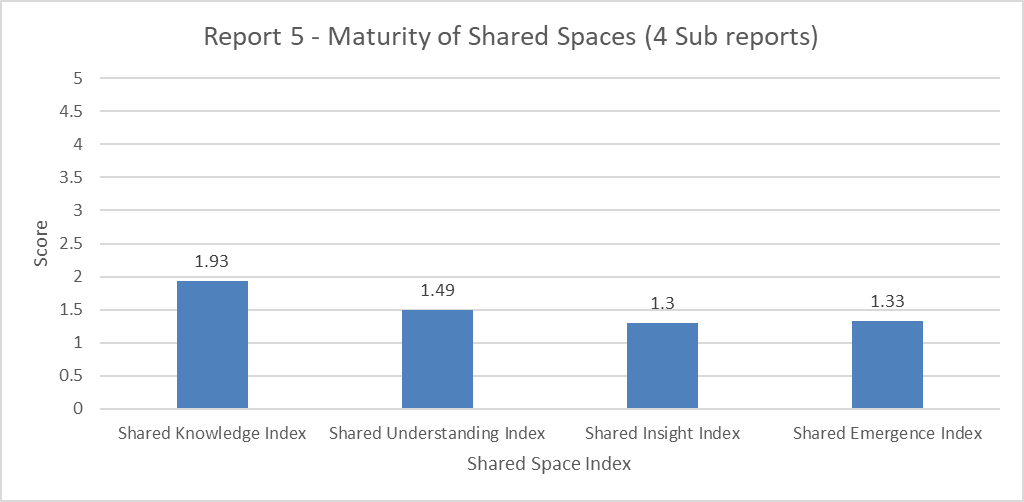
Figure: Maturity of Shared Spaces
Headline reading
Shared Knowledge is the strongest space (1.93), while Shared Insight is the weakest (1.30). Overall, all four spaces are well below the maturity threshold, indicating that learning may exist as information and activity, but the connective flow needed for alignment, insight generation, and coordinated adaptation is weak.
C. Interpretation (patterns and meaning)
C1. Where the learning flow is breaking
The pattern suggests a common sequence: organizations can create or circulate knowledge (Shared Knowledge), but struggle to convert it into shared meaning and standards (Shared Understanding), and struggle even more to produce decision-quality insight from experience and data (Shared Insight). When Shared Insight is weak, Shared Emergence becomes fragile—actions become local, inconsistent, and hard to scale.
C2. What this looks like in practice
- Multiple teams ‘know things’, but they interpret them differently; standards vary.
- Problem diagnosis repeats because patterns are not captured and reused.
- Learning remains episodic (events/projects) rather than compounding (institutional memory).
- Innovation or improvements occur, but they do not reliably scale into BAU.
D. Likely root causes (diagnostic hypotheses)
Given the low Shared Understanding and Shared Insight, the most probable root causes to test are:
- Weak alignment mechanisms: no consistent forums/cadences for agreeing on standards, priorities, and interpretations.
- Limited ‘sense-making’ infrastructure: data exists, but there are no routines to convert it into patterns and decisions.
- Content-to-context gap: knowledge assets are not translated into task playbooks, checklists, and observable proficiency markers.
- Fragmented learning memory: successes/failures are not tagged and reused, so insight does not compound.
E. What to do next (Arena-first vs Pathway activation)
Because all shared spaces are below threshold, prioritize Arena-first scaffolds for each space. Build the minimum routines and assets that make the space functional, then activate pathways (scale, replicate, and connect) once stability is visible.
E1. Arena-first scaffolds by shared space
Shared Knowledge (1.93)
- Create a role→task→asset map: each critical task has a single ‘source of truth’ (standard work + tacit tips).
- Introduce version control and monthly refresh from SMEs/top performers.
- Measure usability: access, completeness, and usage in coaching/practice.
-
Shared Understanding (1.49)
- Define shared standards: proficiency markers, quality criteria, and ‘what good looks like’ per role/task.
- Run monthly alignment reviews: clarify interpretations, remove ambiguity, reset priorities.
- Ensure managers use the same standards in feedback and evaluation.
-
Shared Insight (1.30)
- Create an insight routine: capture signals → analyze patterns → decide actions → document learnings.
- Link data to work: connect learning and performance data to operational KPIs (lead/lag).
- Tag insights for reuse (problem type, context, decision, outcome) to build institutional memory.
-
Shared Emergence (1.33)
- Establish an experiment pipeline: small pilots with clear hypotheses, measures, and review cycles.
- Define how pilots become BAU: criteria, owners, training/enablement, and rollout plan.
- Create cross-team forums to share learnings and replicate successful changes.
-
E2. Measures to track (next cycle)
- Shared Knowledge: asset coverage % for critical tasks; usage in coaching; content freshness.
- Shared Understanding: % roles with defined proficiency standards; variance reduction across teams.
- Shared Insight: number of decisions supported by documented insight; cycle time from signal→decision.
- Shared Emergence: % pilots scaled to BAU; repeatability of improvements across teams/functions.
F. Data note
This report uses the shared space index values shown in your ‘Maturity of Shared Spaces’ chart as the reporting truth (Shared Knowledge 1.93, Shared Understanding 1.49, Shared Insight 1.30, Shared Emergence 1.33). The matrix view is included to show how those indices were extracted.
Ready to get started?
Get in touch now!