
Maturity of Stratified Layers (Frontline, Manager, Leader)
This report reads learning maturity through stratified layers of the organization—Frontline, Managers, and Leaders. The purpose is to identify where the learning system is strongest, where stewardship is breaking, and which layer must be strengthened first to enable system-wide movement. This is not a ‘people rating’; it is a system diagnosis of how each layer holds, transmits, and scales learning and performance.
A. What we measured
We derived three layer indices on a 0–5 scale, aligned to your ‘Maturity of Stratified Layers’ extraction:
- Frontline: maturity of learning and performance practice at the task/role execution edge (where work happens).
- Manager: maturity of translation and enablement—coaching, standards, feedback loops, and operational rhythms.
- Leader: maturity of orchestration—system alignment, strategic direction, cross-team integration, and scaling.
Working maturity threshold reference used for interpretation: 3.0.
B. What we found (data)
B1. Stratified layer extraction view
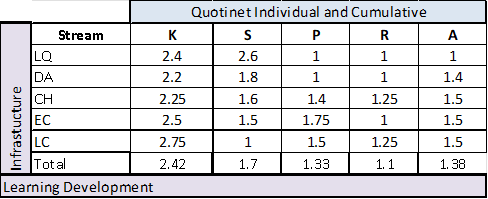
Figure: Stratified layers extraction
B2. Stratified layer maturity scores
| Stratified Layer | Score | Gap to 5.0 |
| Frontline Index | 1.93 | 3.07 |
| Manager Index | 1.49 | 3.51 |
| Leader Index | 1.30 | 3.70 |
B3. Stratified layer maturity chart
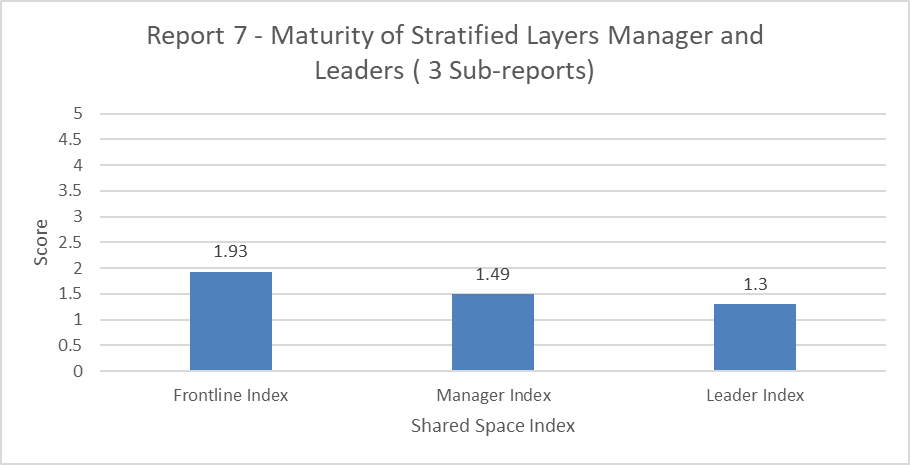
Figure: Maturity of Stratified Layers
Headline reading
Frontline maturity is the highest (1.93), while Manager (1.49) and Leader (1.30) maturity are materially lower. This creates a ‘weak middle + weak top’ pattern: people at the edge may be working and learning locally, but the system is not being held, translated, or scaled effectively through management and leadership.
C. Interpretation (patterns and meaning)
C1. What the layer pattern implies
When Frontline scores higher than Manager and Leader layers, organizations often show pockets of competence and effort, but limited system lift. The constraint is not willingness to work; it is the lack of consistent stewardship mechanisms that convert local learning into repeatable practice and then into cross-team scalability.
C2. What this looks like in practice
- Frontline teams learn ‘in the moment’ but lessons do not travel across shifts, sites, or functions.
- Managers are not consistently running practice/feedback cadences or reinforcing shared standards.
- Leaders run initiatives, but prioritization, resource allocation, and system governance do not reinforce learning conversion.
- Innovation exists, but scale-to-BAU is slow because the middle layer (managers) cannot replicate reliably.
D. Likely root causes (diagnostic hypotheses)
Given the Manager and Leader indices, the most probable root causes to test are:
- Manager layer: weak coaching capability, inconsistent performance conversations, and limited on-job validation routines.
- Manager layer: absence of shared proficiency standards (‘what good looks like’) used in evaluation and feedback.
- Leader layer: weak system governance&R cadence—insight review, decision-making, and constraint removal are not rhythmic.
- Leader layer: scaling infrastructure is thin—playbooks, replication forums, and cross-team learning mechanisms are not institutionalized.
E. What to do next (interventions by layer)
Because all layers are below threshold, the next cycle should be Arena-first. However, the highest leverage is to strengthen Managers and Leaders, because they are the transmission and scaling mechanisms for the system.
E1. Frontline (lift from 1.93 → 2.5+)
- Convert knowledge into task playbooks and checklists for critical tasks.
- Introduce simple on-job validation and micro-certification for priority tasks.
- Create peer learning circles focused on deliberate practice + feedback.
-
E2. Managers (lift from 1.49 → 2.5+)
- Manager operating rhythm: weekly practice + feedback; monthly proficiency review.
- Coach-to-standards: define and use observable proficiency markers for roles/tasks.
- Capture and close gaps: maintain a visible ‘skill-to-performance gap board’ and act on it.
-
E3. Leaders (lift from 1.30 → 2.5+)
- Governance cadence: monthly review of P/R/A movement; decide focus cells, unblock constraints, allocate resources.
- Build a replication pipeline: pilot → validate → document playbook → scale into BAU.
- Institutionalize cross-team learning: forums for insight sharing, pattern capture, and standardization.
-
E4. Measures to track (next cycle)
- Frontline: task playbook coverage; validation completion rates; reduction in critical errors/defects.
- Managers: coaching cadence adherence; % roles with proficiency standards used; variance reduction across teams.
- Leaders: decision cycle time from insight→action; % pilots scaled; systemic uplift in P/R/A blocks.
-
F. Data note
This report uses the layer index values shown in your reference chart as the reporting truth (Frontline 1.93; Manager 1.49; Leader 1.30). The extraction view is included to show how the indices are constructed from the underlying matrix.
Ready to get started?
Get in touch now!