Maturity of Systems
This report groups the five learning streams into three higher-order Systems and reads the maturity of each system. The intent is to see whether the organization’s learning maturity is primarily constrained by the Organizational System (standards, governance, visibility), the Enabler System (content, enablement, transfer), or the Learning System (practice, feedback, conversion into performance).
A. What we measured
We aggregated stream maturity into three systems, aligned to the structure shown in your worksheet:
- Organizational System: Learning Quotient (LQ) + Digital Analytics (DA).
- Enabler System: Content Hierarchy (CH) and its conversion mechanisms into enablement routines.
- Learning System: Enablers Cycle (EC) + Learning Cycle (LC), representing practice, feedback, and capability conversion.
Each system is scored on a 0–5 scale using the same scoring backbone (K, S, P, R, A). Working threshold reference for interpretation: 3.0.
B. What we found (data)
B1. Systems mapping
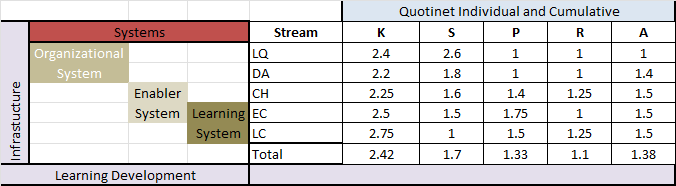
Figure: Systems grouping mapped to streams
B2. System maturity scores
| System | System Maturity Score |
| Learning System | 1.625 |
| Enabler System | 1.625 |
| Organizational System ( LQ+DA ) | 1.605 |
B3. System maturity chart
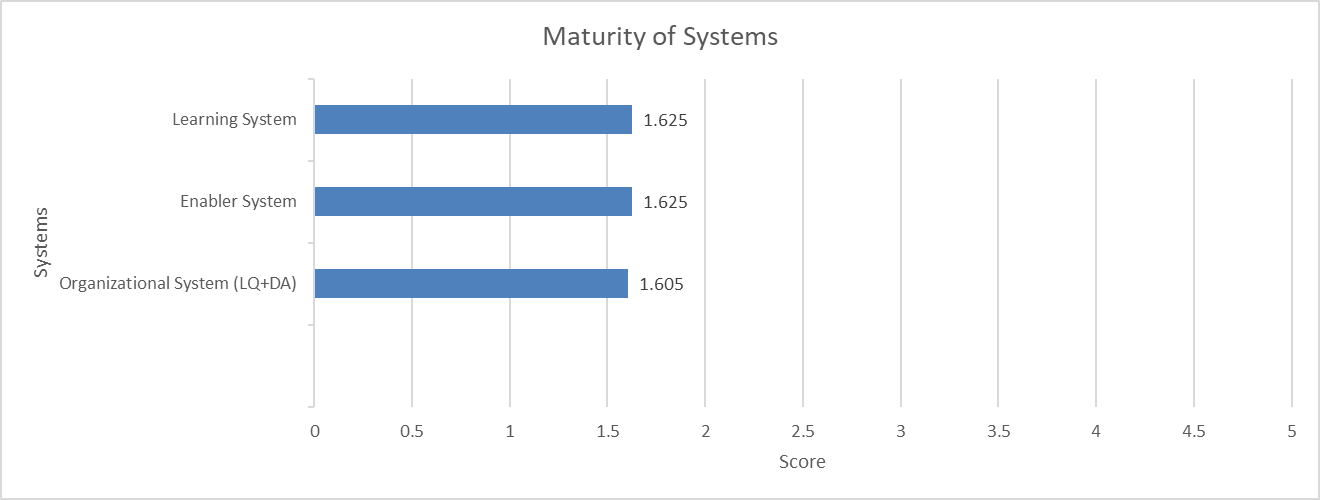
Figure: Maturity of Systems
B4. Supporting stream-level values
| Stream | K | S | P | R | A | Stream Score (avg K-A) |
| LQ | 2.40 | 2.60 | 1.00 | 1.00 | 1.00 | 1.60 |
| DA | 2.20 | 1.80 | 1.00 | 1.00 | 1.40 | 1.48 |
| CH | 2.25 | 1.60 | 1.40 | 1.25 | 1.50 | 1.60 |
| EC | 2.50 | 1.50 | 1.75 | 1.00 | 1.50 | 1.65 |
| LC | 2.75 | 1.00 | 1.50 | 1.25 | 1.50 | 1.60 |
Headline reading
System maturity is clustered in a narrow band (≈1.605–1.625). The Organizational System is marginally lower (1.605), while Enabler and Learning Systems are slightly higher (both 1.625). The overall message remains: the system is uniformly constrained, and improvement needs to target conversion breaks, not only one subsystem.
C. Interpretation (patterns and meaning)
C1. What it means when systems are uniformly low
When all three systems sit at similarly low maturity, it typically means the organization has activity across the board—some content, some training, some practice, some metrics—but lacks the scaffolds that make learning repeatable and outcome-linked. Uniform low maturity is a signature of weak integration: systems exist, but they do not reinforce each other through a closed feedback loop.
C2. Where the constraint shows up (block pattern)
Across the underlying blocks, Knowledge (K=2.42) and Skill (S=1.70) are relatively stronger, but Performance (P=1.33), Revenue/Context (R=1.10), and Agility (A=1.38) remain low. This indicates the core constraint is the conversion of inputs into outcomes, not the existence of inputs.
D. Likely root causes (diagnostic hypotheses)
Based on the systems profile and the K→A drop, the most probable causes to test are:
- Organizational System: unclear standards for proficiency and weak governance rhythms (review, decision, resource allocation).
- Enabler System: content exists but is not structured as task playbooks; transfer mechanisms are inconsistent.
- Learning System: practice and feedback are not designed into work; validation of proficiency is uneven across teams.
- Analytics: data capture exists, but does not connect learning activities to operational KPIs and business outcomes.
E. What to do next (interventions by system)
E1. Organizational System moves (LQ + DA)
- Define proficiency standards for priority roles/tasks; publish ‘what good looks like’ as observable markers.
- Set a monthly governance rhythm: review P/R/A movement, decide focus cells, remove constraints, allocate support.
- Build a minimum analytics spine: participation → practice → proficiency → outcome data, linked to operational KPIs.
-
E2. Enabler System moves (CH)
- Convert content into execution assets: standard work + tacit tips + common errors + checklists.
- Institutionalize capture: monthly best-practice harvest from SMEs/top performers with version control.
- Design transfer: every learning asset should specify practice steps, time-on-task, and validation method.
-
E3. Learning System moves (EC + LC)
- Embed weekly practice + feedback routines; ensure managers coach to proficiency markers.
- Introduce on-job validation: observation, task checks, micro-certification for critical tasks.
- Add reflection loops: monthly ‘what changed in practice’ reviews to reinforce learning-to-performance conversion.
-
E4. Measures to track
- Leading: % roles with defined proficiency standards; coaching cadence adherence; % validated practice cycles completed.
- Lag: uplift in P/R/A block scores; reduction in variance across teams; improvement in task KPIs.
- Systems: improvement in Organizational System score as governance and sensing mature.
-
F. Data note
The Organizational System score in your chart is shown as 1.605. Using the stream averages from the matrix, (LQ+DA) computes to 1.540. Minor differences are typically due to rounding or the use of weighted averages. This report retains the chart values as the reporting truth and uses the matrix for explanatory support.
Ready to get started?
Get in touch now!