System vs Human Development (Origin Map)
This report establishes the organization’s ‘origin point’ by separating two forces that together determine learning maturity: (1) the strength of the learning infrastructure (inputs that make learning possible), and (2) the strength of human development (the conversion of learning into performance, contextual impact, and agility). The output is an origin map that shows where the organization is currently anchored and what kind of intervention is most likely to move it.
A. What we measured
We used the Streams × Blocks matrix (LQ, DA, CH, EC, LC across K, S, P, R, A) and decomposed maturity into two indices:
Infrastructure Development Index = average of Knowledge + Skill blocks (K and S).
Human Development Index = average of Performance + Revenue/Context + Agility blocks (P, R and A).
Interpretation guide (working reference): scores closer to 5 are mature; scores below the threshold line indicate scaffold-building is required.Agility (A): adaptability, resilience, and capacity to respond to change.
Working threshold used in the origin map: 3.0.
B. What we found (data)
B1. Core matrix (Streams × Blocks)
| Stream | K | S | P | R | A | Stream Score (avg K-A) |
| LQ | 2.40 | 2.60 | 1.00 | 1.00 | 1.00 | 1.60 |
| DA | 2.20 | 1.80 | 1.00 | 1.00 | 1.40 | 1.48 |
| CH | 2.25 | 1.60 | 1.40 | 1.25 | 1.50 | 1.60 |
| EC | 2.50 | 1.50 | 1.75 | 1.00 | 1.50 | 1.65 |
| LC | 2.75 | 1.00 | 1.50 | 1.25 | 1.50 | 1.60 |
B2. Totals / block averages
| Block | Average | Gap to 5.0 |
| K | 2.42 | 2.58 |
| S | 1.70 | 3.30 |
| P | 1.33 | 3.67 |
| P | 1.10 | 3.90 |
| A | 1.38 | 3.62 |
B3. Derived indices (Infrastructure vs Human)
| Index | Value | Meaning (one line) |
|
Organisation Stream Score (avg of stream scores) |
1.59 |
Overall horizontal maturity across streams (mean of stream scores). |
|
Org Quotient Score (avg of block averages) |
1.59 |
Overall vertical maturity across blocks (mean of block averages). |
|
Infrastructure Development (K–S) |
2.06 |
Strength of learning inputs and enabling structure (knowledge + skill readiness). |
|
Human Development (P–R–A) |
1.27 |
Strength of conversion into outcomes and adaptability (performance + context + agility). |
B4. Origin map
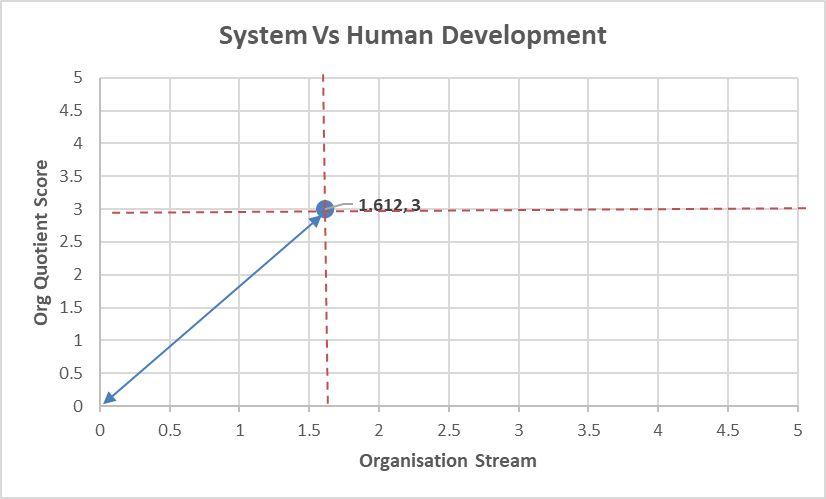
Figure: System vs Human Development origin map
C. Interpretation (patterns and meaning)
The Infrastructure Development Index is 2.06, while the Human Development Index is 1.27. This indicates that learning inputs (knowledge/skill readiness) are meaningfully stronger than the system’s ability to convert those inputs into repeatable outcomes (performance, contextual impact, and agility). In practical terms: the organization can teach, but it struggles to consistently translate learning into business outcomes.
C1. What this origin typically looks like on the ground
- Learning exists as events and content, but on-job proficiency validation is inconsistent.
- Manager coaching and cadence discipline vary by team, creating uneven performance conversion.
- Operational metrics and learning data are not linked tightly enough to close the improvement loop.
- Agility remains local (pockets of adaptation), not systemic (repeatable sensing-and-response).
C2. Why the gap matters
When Infrastructure is ahead of Human Development, organizations often experience ‘training comfort’—high activity, visible content, and reasonable awareness—without equivalent uplift in performance or business indicators. Closing this gap is the core move required to shift the origin point upward and to the right over time.
D. What to do next (Arena-first vs Pathway activation)
Given that both indices are well below the working threshold, the next cycle should be Arena-first: build scaffolds that make conversion repeatable. Once conversion is stable, activate Pathways by scaling what works across streams and layers.
D1. Arena-first priorities (90-day levers)
- Proficiency scaffolds (P): define ‘good’ as observable standards for priority roles/tasks; run on-job validation weekly.
- Impact scaffolds (R): link task performance indicators to business outcomes; establish lead/lag measures and monthly reviews.
- Agility scaffolds (A): create a sensing-and-response rhythm (signal capture → experiment → learn → standardize) at function level.
- Conversion scaffolds (K/S → P): convert content into task playbooks and enforce practice + feedback routines through managers.
D2. Measures to track
- Leading: % roles with defined proficiency standards; % staff completing validated practice cycles; coaching cadence adherence.
- Lag: uplift in P/R/A block averages in the next run; reduction in variance across streams and teams; improvement in task KPIs.
- Analytics: completeness of capture across participation → practice → proficiency → outcome.
E. Data note (consistency)
The totals row you shared (K=2.42, S=1.70, P=1.33, R=1.10, A=1.38) aligns with the averages computed from the stream rows. All computations in this report are derived directly from the values shown in the matrix.