Streams Maturity
This report reads learning maturity horizontally across the five Learning Streams—Learning Quotient (LQ), Digital Analytics (DA), Content Hierarchy (CH), Enablers Cycle (EC), and Learning Cycle (LC). The intent is to understand where the learning system is strong, where it is constrained, and what stream-level moves will lift maturity over the next cycle.
A. What we measured
Each stream is scored across five Blocks: Knowledge (K), Skill (S), Performance (P), Revenue/Context (R), and Agility (A), on a 0–5 scale. The Stream Score is the mean of K–A for each stream. A ‘best score’ reference is 5.0, and a working maturity threshold for interpretation is 3.0.
- Stream Score (avg K–A): shows overall maturity of that learning stream.
- Gap to 5.0: shows how far the stream is from an idealized mature state.
- Block pattern (K→A): shows where maturity drops and where conversion breaks occur.
B. What we found (data)
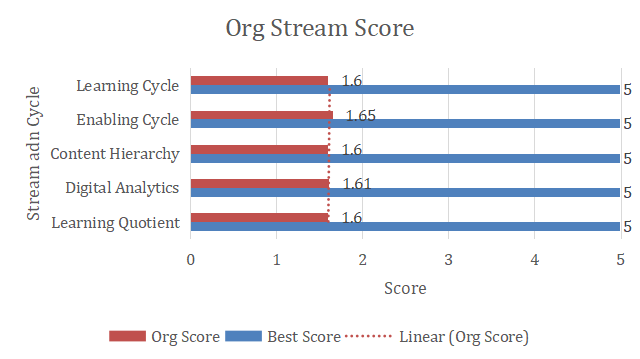
B1. Stream Scores vs Best Score (5.0)
| Stream | Stream Score (avg K-A) | Gap to 5.0 |
| LQ | 1.60 | 3.40 |
| DA | 1.48 | 3.52 |
| CH | 1.60 | 3.40 |
| EC | 1.65 | 3.35 |
| LC | 1.60 | 3.40 |
B2. Streams × Blocks matrix (underlying values)
| Stream | K | S | P | R | A | Stream Score (avg K-A) |
| LQ | 2.40 | 2.60 | 1.00 | 1.00 | 1.00 | 1.60 |
| DA | 2.20 | 1.80 | 1.00 | 1.00 | 1.40 | 1.48 |
| CH | 2.25 | 1.60 | 1.40 | 1.25 | 1.50 | 1.60 |
| EC | 2.50 | 1.50 | 1.75 | 1.00 | 1.50 | 1.65 |
| LC | 2.75 | 1.00 | 1.50 | 1.25 | 1.50 | 1.60 |
Headline Reading
All streams are tightly clustered between 1.48 and 1.65. The highest stream is EC (1.65), and the lowest is DA (1.48). This tight clustering signals a system-wide maturity ceiling rather than a single-stream failure.
C. Interpretation (patterns and meaning)
C1. The system-wide maturity ceiling
When stream scores are tightly clustered at a low level, it usually means the constraint is shared across streams—typically at the block transition points (Skill → Performance, Performance → Revenue/Context, and Revenue/Context → Agility). Improving one stream in isolation will not materially shift the overall posture unless the conversion breaks are repaired.
C2. Block pattern that explains the stream ceiling
Across streams, Knowledge (K=2.42) is relatively higher and Skill (S=1.70) is moderate, but the system drops sharply at Performance (P=1.33) and Revenue/Context (R=1.10). Agility remains low (A=1.38). This shape indicates: learning exists as inputs, but conversion into outcomes is inconsistent.
D. Stream-by-stream diagnostic implications
Below are stream-specific implications and likely levers. Note that these actions should be executed while also fixing the shared conversion breaks.
LC — Stream score 1.60
- Embed practice into weekly rhythms: task practice + feedback cannot be optional.
- Define proficiency markers per role/task so ‘good’ is observable and coachable.
- Add a monthly reflection loop (what worked, what didn’t, what changes next).
EC — Stream score 1.65
- Shift from completion metrics to on-job validation (observation, task checks, certification).
- Equip managers with coaching kits: what to look for, how to correct, how to reinforce.
- Standardize the conversion rhythm: train → practice → evaluate → certify
CH — Stream score 1.60
- Convert content into execution assets: explicit guides → tacit tips → task playbooks.
- Capture best practices monthly from SMEs/top performers and update playbooks.
- Tag content to role → task → performance outcome (not just topics)
DA — Stream score 1.48
- Define a minimum analytics spine: participation → practice → proficiency → outcomes.
- Connect HRMS/LMS/coaching data to task KPIs and operational review cadences.
- Track lead/lag indicators per role and review monthly to close the loop.
LQ — Stream score 1.60
- Standardize role clarity, onboarding completion, and skill certification expectations.
- Run gap-to-journey logic: identify gaps → assign journeys → measure outcomes.
- Create quarterly learning governance: decide focus cells, allocate resources, review movement.
E. What to do next (Arena-first vs Pathway activation)
Because all stream scores are below the working maturity threshold, the next cycle should be Arena-first: build scaffolds that create repeatable conversion from learning inputs to outcomes. Once the conversion is stable, activate pathways by scaling what works.
E1. Arena-first priorities (highest leverage constraints)
- Fix Revenue/Context (R=1.10) — the weakest block, and the strongest constraint to business impact.
- Fix Performance (P=1.33) — make proficiency visible and validated.
- Strengthen Agility (A=1.38) — build sensing-and-response routines that scale beyond pockets.
E2. 90-day move set (minimum viable upgrades)
- Define proficiency standards for top roles/tasks; run on-job validation weekly.
- Introduce lead/lag measures for task performance and review them monthly at function level.
- Build/refresh task playbooks (CH) and ensure they are used in coaching conversations (EC/LC).
- Create a simple analytics capture pipeline (DA) to link learning activity to task outcomes.
E3. Measures to track
- Leading: % roles with proficiency standards; % employees completing validated practice cycles; coaching cadence adherence.
- Lag: uplift in P and R block scores next cycle; reduced variance between streams; improved task KPIs in BAU.
- Analytics: completeness of participation → practice → proficiency → outcome data.