Re-thinking and Re-framing the idea of Leaders and their identities
Leadership development is one of the most expensive and least effective investments in organizations today. Globally, companies spend $35–40 billion on formal leadership training and nearly $366 billion when you include broader leadership and management development. Yet the results remain unchanged. The numbers tell the story clearly:
- Only 12% of organizations believe they have a strong bench of future-ready leaders.
- Fewer than 20% feel confident in their succession plan.
- On average, only 49% of critical roles can be filled internally.
- 44% of new CEOs are now hired from outside — evidence of collapsing internal pipelines.
- Nearly 60% of first-time managers fail within two years.
- Global employee engagement remains stuck at 15–18%, unaffected by decades of leadership programs.
- 70–75% of HR leaders say their leadership development efforts do not deliver
This is not underinvestment. This is systematic failure.
We are producing managers who operate processes, but not leaders who can read systems. We are promoting strong performers but not developing people who can hold complexity. We are training for skills and behaviors but not transforming the Actor behind them.
After years designing programs, coaching leaders and observing teams across layers, one conclusion has become impossible to ignore: our definition of leadership is wrong. It is incomplete, shallow, and disconnected from how leaders actually grow.
Most organizations treat leadership as:
- a set of skills,
- a list of competencies,
- a catalogue of behaviors,
- or a profile of traits.
These help people perform and manage, but they do not create leaders who can sense systems, navigate emergence, or make decisions that hold long-term consequences.
To fix leadership development, we must fix the definition.
This article attempts exactly that not by adding another competency model but by rebuilding leadership from the architecture of learning and stratified layers of Organization structure using:
- the Three Arcs of Learning (Skill, Competence, Inner Arc),
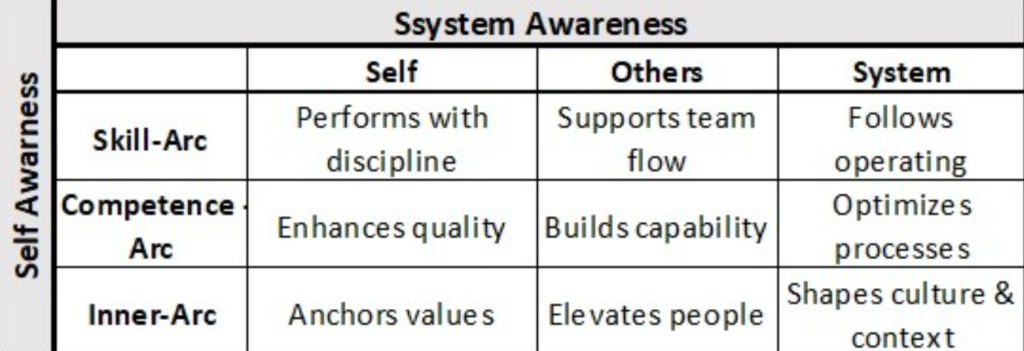
- the Leadership Awareness Matrix (a 3×3 map of Self, Others and System across these arcs),
- and the 5×5 Leadership Maturity Grid (mapping these arcs across organizational layers from Execution to Environment).
Together, these constructs offer a practical, universal, system-grounded definition of leadership — and a developmental pathway for building leaders at every level.
The Three Arcs of Learning: Skill, Competence and Inner Arc
Careers begin similarly: a person is hired to perform tasks. Over time, they are expected to improve, support others, and eventually handle more complex responsibilities. Underneath job titles and promotions, people move through three arcs of learning.
The Skill Arc is the outer arc — the zone of doing. Here the focus is execution: accuracy, speed and discipline. The questions are simple: What should I do? How do I do it correctly? This is the world of SOPs, tools and direct feedback. In Actor–Action–Act terms, this is the Act — the visible output.
The Competence Arc goes deeper. Now the focus is on doing things well and helping others do them well. Questions shift to: How do I improve quality? How consistent am I? How do I help my team perform? Competence includes mastery and attitude — responsibility, ownership and willingness to learn. Reflection begins here, and the person starts influencing the Action — the routines and processes of work.
The Inner Arc is where leadership begins. This arc holds mental models, values and beliefs. The questions deepen: Who am I in this system? Why does this work matter? What do I believe about people and performance? This is where identity is shaped. Most leadership programs try to install behaviors without building this arc, which is why change doesn’t sustain. Shallow Skill or Competence arcs weaken execution; a shallow Inner Arc weakens leadership.
To build better leaders, we must work intentionally across these arcs.
The Leadership Awareness Matrix: Self, Others and System
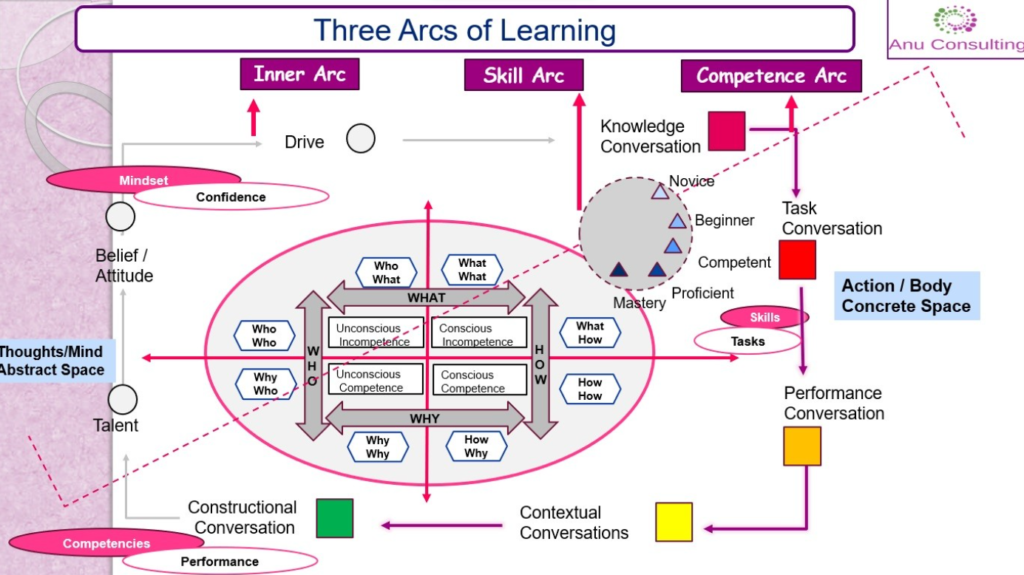
The Three Arcs describe learning depth. Leadership also requires breadth: the ability to act with awareness of Self, Others, and the System.
When we cross these three directions with the three arcs, we get the Leadership Awareness Matrix — a 3×3 foundation for understanding leadership maturity.
Along the Skill Arc, Self-awareness is performs with discipline; toward Others, it shows up as supports team flow; toward the System, it becomes follows operating rhythm. This is where most training focuses — essential, but insufficient.
Along the Competence Arc, Self-awareness becomes enhances quality; toward Others, it becomes builds capability; toward the System, it becomes optimizes processes. Many strong managers operate here — reliable, respected, but still working inside the system.
Along the Inner Arc, Self-awareness becomes anchors values; toward Others, it becomes elevates people; toward the System, it becomes shapes culture and context. This is where leadership emerges — at the intersection of Inner Arc × Others × System.
The Leadership Awareness Matrix is simple enough for a frontline supervisor and powerful enough for a CEO. It reveals where someone is strong and where they need development. But organizations operate across more than Self/Others/System. They operate across stratified system layers.
From 3×3 to 5×5: Leadership Across Organizational Layers
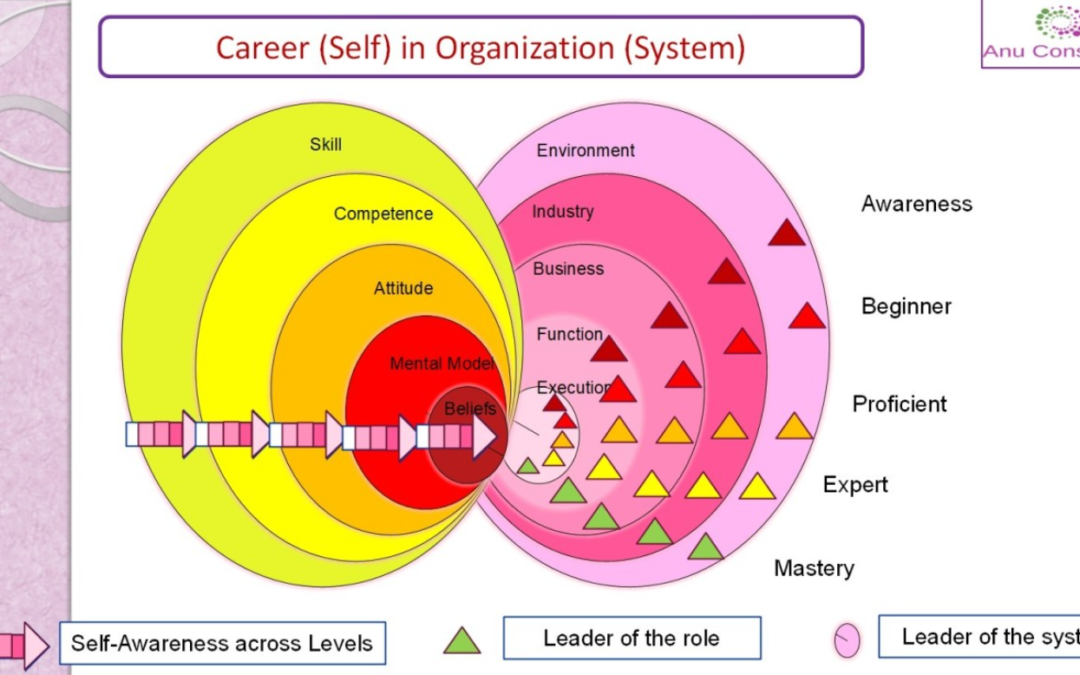
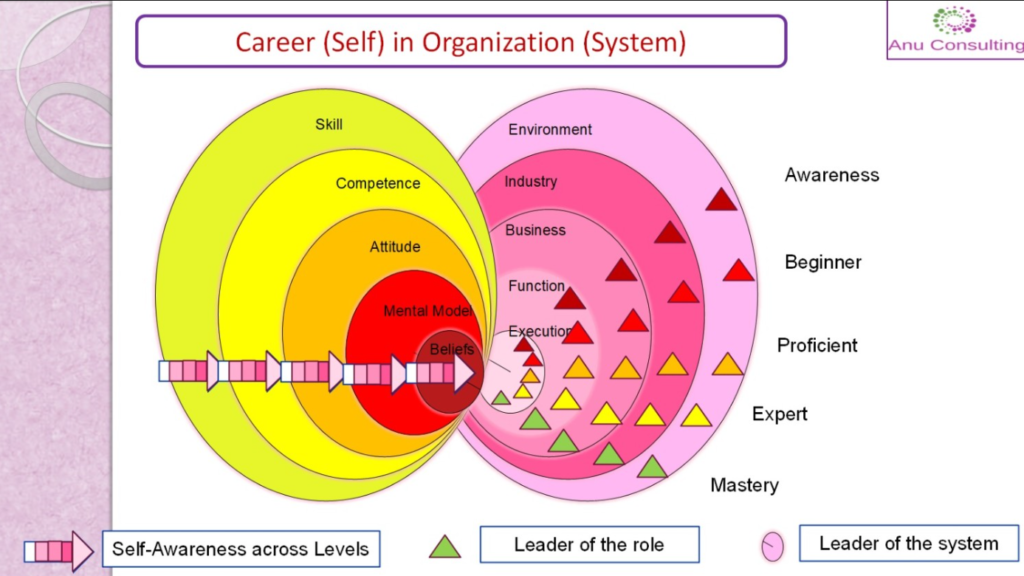
Your “Career Growth (Self) in Organization (System)” diagram captures the reality: people must grow their awareness across five system layers:
- Execution: close to tasks
- Function: patterns across a domain
- Business: integrating functions to drive performance
- Industry: competitive and regulatory dynamics
- Environment: societal, economic and ecological context
When we cross these five layers with the five self-awareness layers (Skill, Competence, Attitude, Mental Model, Belief/Identity), we get the 5×5 Leadership Maturity Grid — twenty-five distinct expressions of how a person shows up in the system.
At the Skill row: executes accurately, supports routines, delivers inputs, follows norms, notices context. Solid individual contributors.
At the Competence row: refines performance, strengthens flow, improves levers, adopts practices, aligns stakeholders. Strong supervisors and managers.
At the Attitude row: shows ownership, enables others, balances priorities, promotes ethics, guides outcomes. Natural early leaders — high energy, reliable, values-driven.
At the Mental Model row: learns from feedback, designs improvements, integrates decisions, senses patterns, interprets dynamics. Early system leaders who understand how pieces influence one another.
The Belief/Identity row is where full leadership appears:
- anchors discipline (Execution)
- builds culture (Function)
- serves purpose (Business)
- shapes norms (Industry)
- stewards ecosystems (Environment)
These are five different leadership archetypes, each defined by Inner Arc depth and the system layer they can hold.
The 5×5 grid also explains everyday failures:
- People promoted into system layers their Inner Arc cannot yet hold. They can’t perceive the layer they must lead and default to control or avoidance.
- People with deep Inner Arc maturity remain trapped in lower layers, where the organization underuses their ability to shape wider patterns.
Leadership is never “next role up.” It is Inner Arc depth × system layer fit.