Metaphor: “Mirror, Mirror on the Wall…”
The Learning Maturity Matrix (LMM) isn’t a magic mirror, but it reflects something far more powerful — the collective ability of your people, the embedded capability of your teams, and the evolving capacity of your organization to thrive in change.
Why LMM? Why Now?
Organizations sit across a spectrum of learning agility. Some demonstrate high learning hunger and habit — supported by systems and culture. Others lag not from lack of will, but because of deeper systemic constraints: business models, industry volatility, or legacy structures.
Before applying LMM, we must accept a critical truth: not all organizations start at the same point. LMM helps each locate their true position — not to compare, but to clarify their own next move.
What Influences Learning Maturity?
LMM isn’t just a framework. It’s a strategic lens informed by:
- Leadership Beliefs & Behaviors
- Digital Infrastructure & Content Maturity
- Managerial Bandwidth & Capabilities
- Performance vs. Compliance Orientation
- Organizational Lifecycle & Talent Philosophy
- Cultural Readiness & Psychological Safety
- Industry Clock Speed
- Ecosystem Participation
- Historical Experience with Learning
- Budget Prioritization & Resource Commitment
- These aren’t checkboxes — they’re conditions that shape learning culture, investment, and impact.
- What LMM Helps You Achieve
LMM serves two key objectives:
Assessment: Accurately identify your position along the learning agility continuum.
Activation: Prioritize whether your next investments go toward infrastructure, human capability — or both.
It offers strategy clarity, confidence in investments, and a visible link between effort and outcome.
Revisiting the Journey: From Pieces to a System
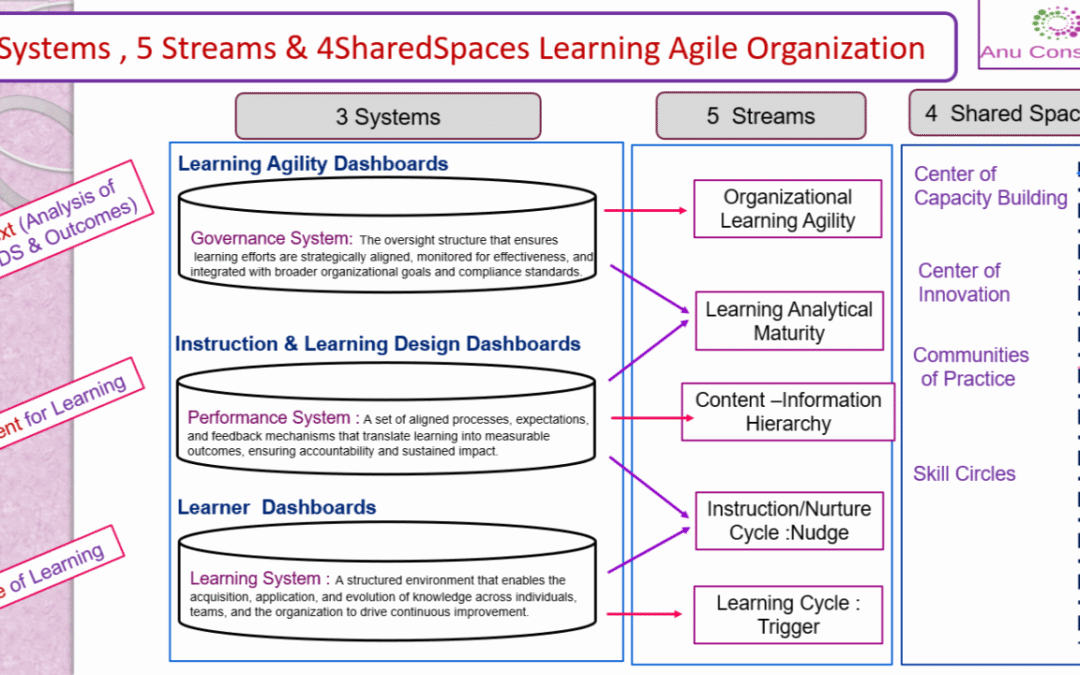
This article concludes a deeper journey. Together, we’ve surfaced:
The 5 Streams:
Learning Cycle · Nudge Cycle · Content Hierarchy · Analytics Maturity · Agility Quotients
The 3 Systems:
Learning · Performance · Governance
The 4 Collective Structures:
Skill Circles · Communities of Practice · Centers of Innovation · Capacity Building Hubs
The 5 New Learning Roles:
Strategist · Designer · Architect · Analyst · Curator
What emerges is a Learning-Agile Organization:
Contextual · Continuous · Collective · Coherent · Capability-driven
What a Learning-Agile Organization Looks Like
Learning is pulled by need — not pushed by calendar
Culture is shaped through learning — not just supportive of it
Managers coach — they don’t just manage
Knowledge flows laterally — not just top-down
Capability building aligns business goals with human potential
And most powerfully — learning becomes identity, not activity
Call to Action: Let’s Pilot, Build, Learn Together
This series was just the beginning.
If this vision resonates:
Comment on what resonated most
Share your current experiments in building learning-agile systems
Collaborate to pilot or contextualize LMM for your ecosystem
Soon, we’ll be releasing a Quick Reference Handbook + Toolkit:
Self-assessment with 200+ indicators
Templates for Skill Circles, CoPs, and Learning Governance Models
Dashboards and Design Guides tailored to your stage of maturity
Let’s move from intent to impact.
Because the future of learning isn’t built by experts alone.
It’s shaped by those bold enough to learn, design, and lead — together.
The Learning-Agile Organization: Built for Change. Powered by Design. Sustained by Culture.
I welcome your thoughts and perspectives—feel free to share them here or write to me at selfnsystems@gmail.com. All conversations around the Learning Maturity Matrix (LMM) are part of my ongoing pro bono effort to support organizations in building learning-agile systems.