Abstract
Organizations, like individuals, learn in cycles. At the individual level, learning unfolds as skills develop into competence, competence matures into mastery, and mastery is anchored in belief and drive. At the organizational level, a parallel but larger cycle unfolds: knowledge embedded in nodes scales through teams, integrates into systems, and regenerates through emergence.
This article introduces a new framing of organizational learning through the Learning Maturity Matrix — a progression from collective knowledge to collective understanding, collective insight, and finally collective vision. These shared spaces map directly onto the organization’s own cycle: Nodes → Teams → Systems → Emergence.
The cycle shows that learning in organizations is not simply the accumulation of skills or information. It is the progressive transformation of individual fragments into collective meaning, systemic foresight, and regenerative vision. By defining organizational learning in this way, we open a path to sharpen HR, operations, and strategy practices to move beyond alignment and toward regeneration.
Section 1: Introduction
Organizations today face a dual challenge: they must deliver predictable results in the present while preparing to adapt, reinvent, and thrive in the future. Traditional approaches to organizational learning often focus on training individuals or capturing best practices. But these approaches miss the larger truth: learning in organizations is not linear, but cyclical, fractal, and regenerative.
At the level of an individual, learning is visible in the development of skills, the application of competence, the achievement of mastery, and the inner drive that fuels growth if captured and documented which seldom happens . At the level of an organization, the pattern is similar but larger in scale. Organizations learn by connecting knowledge at nodes, integrating it through teams, aligning it into systems, and renewing themselves through emergence.
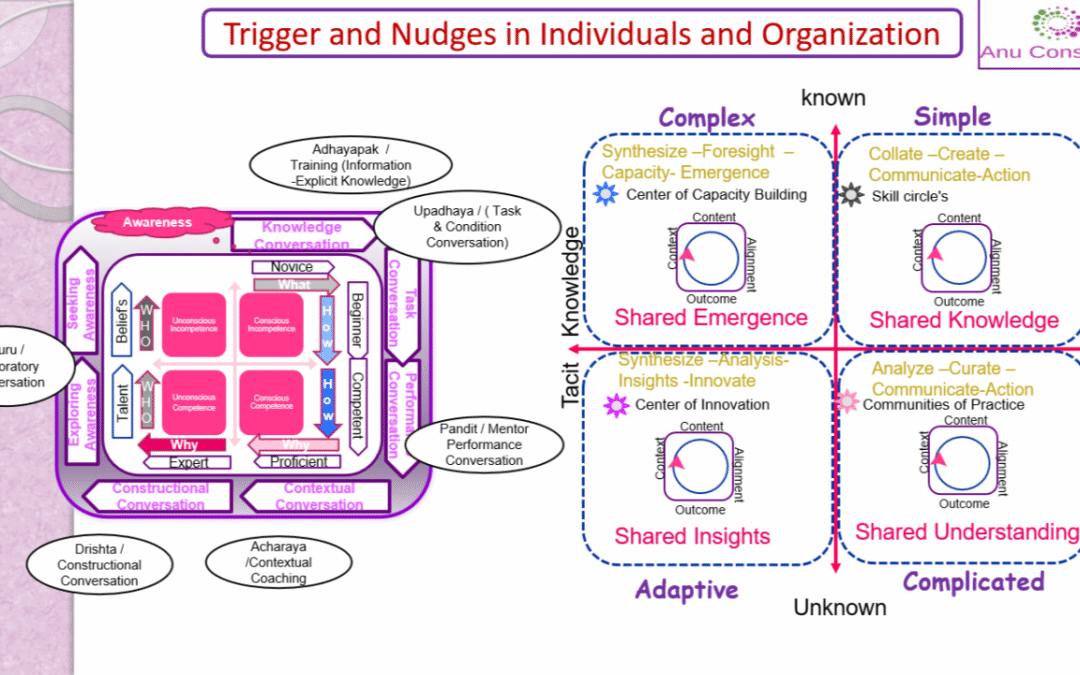
This cyclical view is captured in the Learning Maturity Matrix, which describes the progression from collective knowledge to collective understanding, collective insight, and collective vision. Each of these shared spaces corresponds to a stage of the organizational learning cycle:
- Nodes → Collective Knowledge
- Teams → Collective Understanding
- Systems → Collective Insight
- Emergence → Collective Vision
Seen together, these stages form the organizational equivalent of the individual learning cycle. The structure is fractal: the same learning pattern repeats across different scales — individual, team, system, and organization.
Learning in organizations, therefore, is best understood not as training or information transfer, but as the regenerative transformation of knowledge into vision across interconnected cycles.
Section 2: Defining the Four Levels of the Organizational Learning Cycle
To understand how organizations learn, we must define the four levels of the cycle: Nodes, Teams, Systems, and Emergence. Each level represents a distinct layer of collective performance, each aligned with one of the four shared spaces in the Learning Maturity Matrix: Knowledge, Understanding, Insight, and Vision.
1. Nodes → Collective Knowledge
Nodes are the smallest connection points of knowledge and capability in the organization. A node may be an individual, a role, or even a knowledge repository. It is a carrier of expertise and a connection point in the network.
At the Node level, learning is grounded in collective knowledge — explicit (documents, processes, tools) and tacit (experience, know-how, judgment). Each node holds a fragment of the organizational fabric.
Communication here is transactional and information-heavy: documents, reports, databases, and conversations between individuals. The risk is siloed knowledge that lacks integration.
2. Teams → Collective Understanding
Teams are clusters of nodes working together toward a shared purpose. They represent the first integration layer of organizational learning — where individual fragments combine into collective meaning.
At the Team level, learning is expressed as collective understanding. Teams contextualize knowledge, apply it to real problems, and build shared mental models. Trust, rhythm, and coordination allow the team to move from “what I know” to “what we understand together.”
Communication here is dialogic and interpretive: retrospectives, problem-solving dialogues, and cross-role coordination. The risk is groupthink if teams lack diversity of perspectives.
3. Systems → Collective Insight
Systems are networks of teams integrated into functions, processes, and organizational structures. They represent the coherence of the organization, where learning moves beyond local understanding into system-wide patterns.
At this level, the organization generates collective insight — the ability to see patterns across teams, to understand why outcomes emerge, and to anticipate leverage points. Insights provide foresight, adaptability, and resilience.
Communication is strategic and pattern-seeking: strategy reviews, dashboards, and cross-functional forums. The risk is unused insights — organizational intelligence that never translates into action.
4. Emergence → Collective Vision
Emergence is the stage where new possibilities surface beyond what any node, team, or system could create alone. It is the regenerative capacity of the organization — innovation, foresight, and cultural renewal.
At the Emergence level, learning culminates as collective vision. Vision is not a static statement on a wall; it is a living orientation that emerges from the interplay of insights across the system. It represents who we are becoming as an organization.
Communication here is aspirational and purpose-driven, carried through stories, metaphors, and shared narratives. The risk is vision drift, when the vision is not grounded in systemic insight.
Section 3: The Organizational Learning Cycle in Action
Learning in organizations is not a straight line. It is a cycle — a movement that begins with fragments of knowledge held in nodes, integrates through teams, consolidates into systems, and regenerates through emergence. Each stage builds on the last, but the power lies not in progression alone — it lies in the continuity of the cycle.
- From Nodes to Teams: Knowledge becomes understanding as communication shifts from transactional exchange to dialogic sensemaking.
- From Teams to Systems: Understanding becomes insight as communication shifts from collaborative dialogue to systemic pattern recognition.
- From Systems to Emergence: Insight becomes vision as communication shifts from strategic foresight to aspirational narrative.
- From Emergence back to Nodes: Vision renews knowledge, guiding what new knowledge is created and how roles evolve.
Section 4: The Learning Maturity Matrix Applied
The Learning Maturity Matrix shows how learning maturity is built through communication across shared spaces:
- Knowledge (Nodes): Transactional communication, risk of silos.
- Understanding (Teams): Dialogic communication, risk of groupthink.
- Insight (Systems): Strategic communication, risk of unused intelligence.
- Vision (Emergence): Aspirational communication, risk of vision drift.
Section 5: Fractal Parallels with Individual Learning
The organizational cycle mirrors the individual cycle, showing the fractal nature of learning:

Section 6: Implications for HR, Operations, and Strategy
- HR: Move beyond alignment toward regeneration. Design roles (nodes) for connectivity, steward shared spaces, ensure vision cascades into talent development.
- Operations: Recognize teams as the integration hubs of learning, bridge them into systems, prevent bottlenecks.
- Strategy: Steward emergence, ensure vision regenerates knowledge, anchor foresight in collective purpose.
- Cross-functional: Communication maturity is the engine: transactional → dialogic → strategic → aspirational.
Section 7: Conclusion — Toward a Regenerative Definition of Organizational Learning
Organizational learning is not training, not repositories, not compliance. It is the regenerative transformation of knowledge into vision across interconnected cycles.
Organizational learning is the regenerative transformation of collective knowledge into shared understanding, systemic insight, and collective vision — a cyclical process unfolding across nodes, teams, systems, and emergence.