1. Introduction: Beyond Alignment and Development
In the previous article, we explored the two learning cycles that shape organizational performance: the Alignment Cycle (Being) and the Development Cycle (Becoming). Alignment stabilizes today’s performance by ensuring fit between the role (the Act), the method of performance (the Action), and the performer (the Actor). Development prepares tomorrow’s performance by strengthening the Actor’s capacity, readiness, and potential for growth.
But a persistent challenge remains: learning does not always translate into performance. Organizations invest heavily in training, systems, and knowledge-sharing platforms. Yet only a fraction of employees consistently apply what they have learned. Research shows that barely 18% of employees feel aligned to organizational goals — an indication that alignment alone is not enough.
The missing link is adoption. Adoption is the process through which knowledge is absorbed, practiced, and actualized by the learner. Without adoption, alignment becomes compliance and development remains theoretical. To anchor adoption, we turn to the three fundamental elements of performance: Actor, Action, and Act.
2. Defining the Core Constructs: Actor, Action, and Act
- Act – What is being performed. The defined outcomes, goals, and deliverables of a role. Adoption here means knowledge in action: applying what is already known, executing defined standards, and producing measurable results.
- Action – How it is being performed. The methods, choices, and adjustments made in execution. Adoption here is reflection in action: aligning behavior to expectations, correcting errors, and adapting processes in real time.
- Actor – Who is performing. The individual, team, or organization carrying ability, motivation, and values. Adoption here is reflection on action: developing readiness, strengthening capability, and evolving identity for sustained performance.
By viewing learning adoption through these three elements, we can see that adoption is not uniform. It happens differently depending on whether the learner is anchored in the Act, the Action, or the Actor.
3. The Two Cycles: Alignment and Development
Adoption becomes clearer when mapped to the two cycles:
- Alignment Cycle (Being) – This cycle supports the Act and Action. It ensures that the learner adopts operational learning, aligns behaviors to standards, and delivers expected outcomes. It is essentially reflection in action.
- Development Cycle (Becoming) – This cycle supports the Actor. It ensures that the learner adopts deeper growth, builds resilience, and becomes ready for future challenges. It is essentially reflection on action.
Both cycles are indispensable. Alignment corrects the Act and Action; Development strengthens the Actor. Adoption is how these cycles become visible in performance.
4. Readiness and the Six Levels of Learners
Not every learner adopts at the same pace. Using the six-level learner model (based on ability and motivation), we see distinct adoption patterns:
- Level 6 – Intrinsic Learner (High Ability, High Motivation): adopts rapidly; requires minimal development.
- Level 5 – Integrated Learner (High Ability, High Motivation): adopts quickly; learning aligns with personal identity.
- Level 4 – Identified Learner (Medium Ability, Medium Motivation): adopts moderately; needs structured reinforcement.
- Level 3 – Introjected Learner (Medium Ability, Medium Motivation): adopts inconsistently; motivation fluctuates with pressure or recognition.
- Level 2 – Externally Regulated Learner (Low–Medium Ability, Medium Motivation): adopts only when externally required; fragile internalization.
- Level 1 – Disengaged Learner (Low Ability, Low Motivation): adoption is highly unlikely; requires significant Actor development or eventual exit.

This explains why adoption rates vary. Some learners adopt new practices quickly, while others resist or stagnate despite exposure to the same programs.
5. Readiness Zones: Time-to-Performance
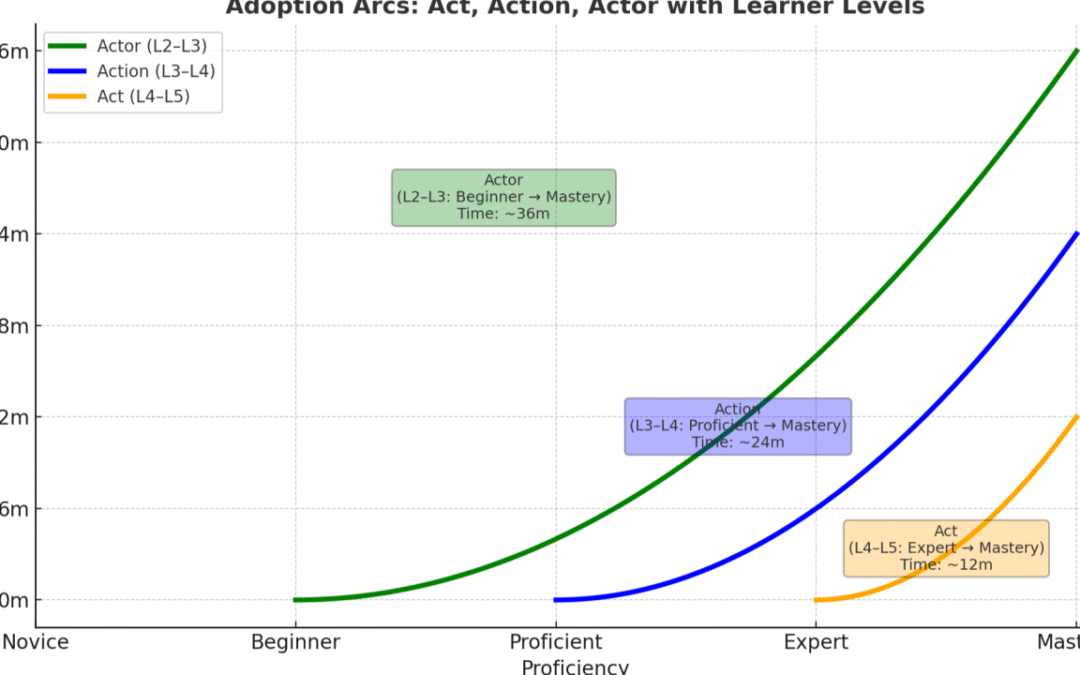
Learner readiness translates directly into time-to-performance. We can categorize adoption across three zones:
- Alignment-Ready Zone (Short Time-to-Performance). Learners in Levels 6 and 5 adopt quickly with minimal intervention.
- Blended Zone (Moderate Time-to-Performance). Learners in Levels 4 to 2 adopt moderately, requiring both alignment and development inputs.
- Development-Heavy Zone (Extended Time-to-Performance). Learners in Level 1 require significant Actor development before adoption is possible.

These zones help leaders set realistic expectations: adoption is not about the content alone, but about matching learning cycles to readiness.
6. Integrated Framework of Adoption
When we bring the elements together, adoption can be seen as the intersection of Actor–Action–Act, the two cycles, and learner readiness:
- Act → Knowledge in Action → Alignment Cycle → Short-term adoption.
- Action → Reflection in Action → Alignment Cycle → Adaptive adoption.
- Actor → Reflection on Action → Development Cycle → Transformative adoption.
Adoption occurs when operational fit (Act and Action) is reinforced by developmental growth (Actor). The Integrated Framework combines readiness zones with cycle intensity, showing leaders how to balance alignment and development efforts depending on the learner’s level.
7. Adoption as the Multiplier
Over the last six decades, organizations have largely confused alignment with development. Most products in the learning marketplace — knowledge repositories, content platforms, bite-sized modules — serve the alignment cycle, not the development cycle. Adoption was assumed to be automatic, when in reality it was dependent on the Actor’s readiness.
This oversight explains why so much training feels full but delivers little. Adoption cannot be left to chance. It must be designed into both cycles:
- Reflection in action to strengthen alignment.
- Reflection on action to build development.
Alignment stabilizes today. Development prepares tomorrow. But adoption is what makes both real. It is the multiplier that transforms organizational investment in learning into actual performance.